
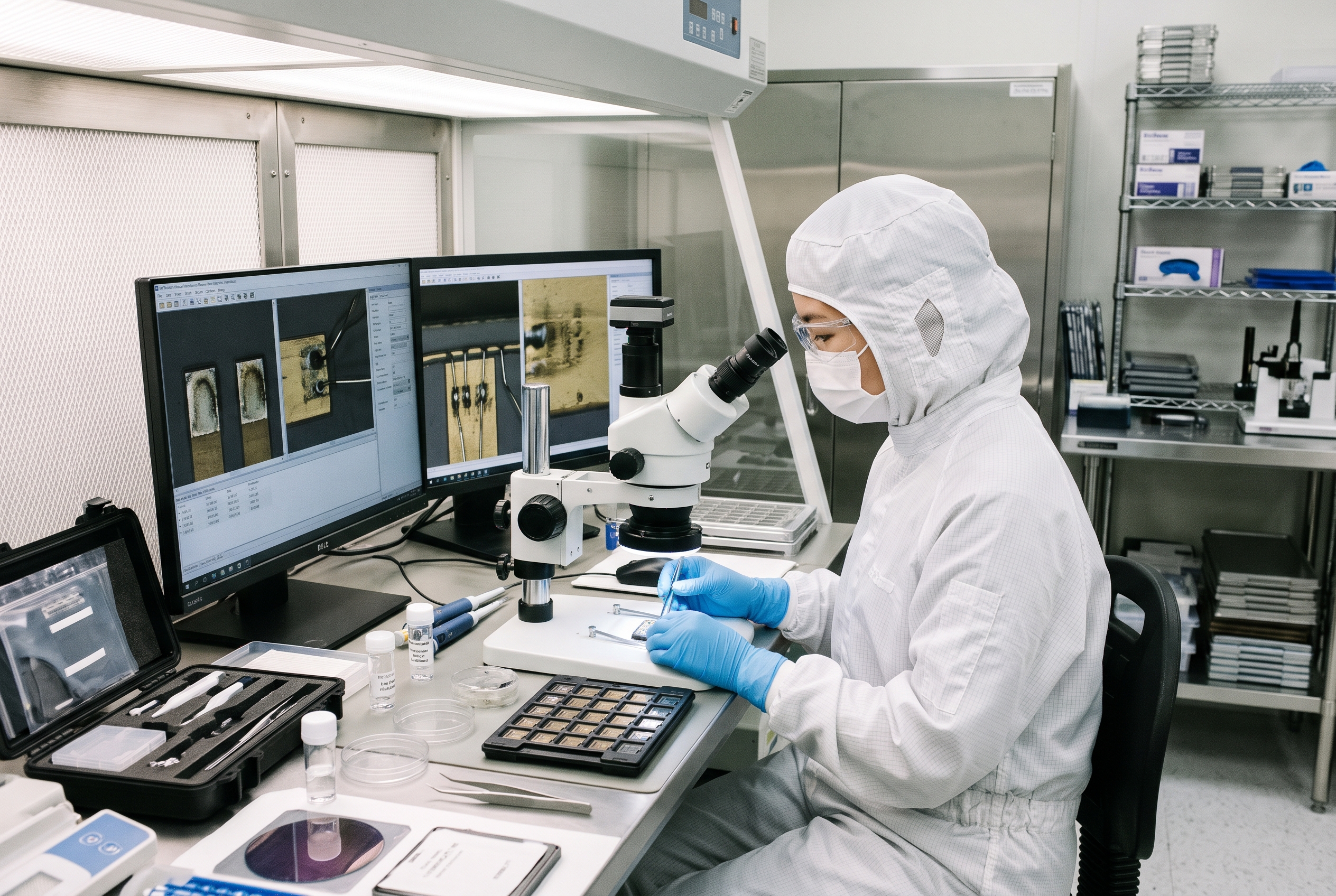
As semiconductor packages, optical sensors, and precision storage drives shrink to microscopic dimensions, metallic circuit interfaces become extraordinarily vulnerable to invisible chemical fallout. Aluminum bond pads, silver plated lead frames, and microscopic copper interconnects can suffer catastrophic open circuits from trace salt quantities measured in mere nanograms per square centimeter. An anion test is a high sensitivity analytical laboratory method using Ion Chromatography to extract and quantify trace negatively charged ions, including chlorides, fluorides, sulfates, and nitrates, from microelectronic components, raw packaging materials, and cleanroom handling supplies. Screening both hardware and its surrounding environment allows engineering teams to intercept corrosive contaminants before expensive silicon yields are lost.
Contamination inside advanced microelectronics rarely comes solely from wet chemical processing. Instead, volatile salts leaching from shipping trays, antistatic gloves, adhesive epoxies, and factory air quietly accumulate on exposed metal pads until operational heat and ambient moisture trigger rapid corrosion.
Invisible Anion Sources Attacking Microelectronic Interfaces
Trace anionic impurities infiltrate cleanroom assembly lines through several subtle material and environmental pathways.
- Chlorides and Fluorides on Aluminum Bond Pads: Microscopic halogen residues originating from wafer plasma etching chambers, impure molding compounds, or incidental bare skin contact penetrate the thin protective aluminum oxide skin on semiconductor die pads. Once breached, continuous cyclic corrosion dissolves the aluminum metallization and causes wire bonds to lift completely.
- Sulfates and Sulfur Species on Silver Interfaces: Trace sulfur bearing compounds outgassing from industrial rubber mats, vulcanized gaskets, or unpurified factory air react rapidly with silver plated lead frames and resistor terminations. This chemical attack generates insulating black silver sulfide tarnish and conductive metallic whiskers that short out adjacent circuits.
- Nitrates and Nitrites from Environmental Fallout: Atmospheric nitrogen oxides and residual cleanroom cleaning agents deposit hygroscopic nitrate films across sensitive optical dies and sensor housings, accelerating localized pitting whenever slight condensation occurs.
- Leachable Salts from Handling Consumables: Returnable carrier trays, embossed shipping tapes, nitrile gloves, and packaging desiccants frequently carry residual industrial salts from polymer manufacturing. Direct physical contact transfers these hidden anions straight onto clean microchips during automated pick and place assembly and overseas transit.
High Technology Industries Relying on Ultra Trace Anion Audits
Maintaining ultra low ionic baselines protects manufacturing yields and operational endurance across precision technology supply chains.
- Semiconductor Packaging and Outsourced Assembly: Chip packaging facilities routinely screen lead frames, epoxy molding compounds, wafer dicing water, and cleanroom wipes to eliminate wire bond pad corrosion and internal package delamination.
- Data Center Hard Disk Drives and Precision Storage: Magnetic read write heads fly mere nanometers above spinning recording media, requiring ultra strict ionic limits on internal drive adhesives, elastomeric seals, and machined motor hubs to prevent head disk crashes.
- Optoelectronics and High Power Light Emitting Diodes: Reflective silver cups inside automotive headlamps and commercial lighting packages lose optical brightness rapidly when trace sulfur or halogen anions migrate through silicone encapsulants and darken reflective metal surfaces.
- Electric Vehicle Power Modules and Battery Management Systems: High voltage silicon carbide inverters and battery monitoring boards operate under intense electric fields that rapidly mobilize trapped anionic impurities beneath conformal coatings, triggering coating blistering and insulation failure.
Safeguarding delicate microelectronic interfaces demands proactive chemical verification across both active components and everyday cleanroom consumables. By integrating a certified anion test through an Alstesting Laboratory Testing service in Malaysia, semiconductor packagers and advanced electronics producers secure authoritative, third party analytical evidence to uphold zero defect reliability across Southeast Asia.
Frequently Asked Questions (FAQ)
How do cleanroom gloves and shipping trays introduce anions onto microchips?
During manufacturing, nitrile gloves undergo chlorination treatments and chemical vulcanization while plastic carrier trays receive antistatic surface coatings that often contain soluble salts. If these consumables are not thoroughly washed and qualified, residual chlorides, sulfates, and nitrates transfer directly onto metallic device leads through physical contact or static attraction.
Why does trace fluoride contamination pose a severe threat to semiconductor wire bonds?
Fluoride ions are exceptionally small and chemically aggressive toward aluminum and aluminum oxide layers used on semiconductor die bond pads. Even submicrogram traces of residual fluoride left behind from wafer etching processes can react with trace moisture inside a molded chip package, progressively turning solid metallic bond pads into brittle, nonconductive corrosion byproducts.
Can ionic residues hidden beneath conformal coatings still cause electronic failure?
Yes, conformal coatings slow moisture entry, but nearly all polymeric coatings remain slightly permeable to water vapor over extended service. When water vapor diffuses through the coating and reaches trapped chloride or sulfate salts resting on the circuit surface, it creates localized osmotic pressure that lifts the coating into blisters and initiates aggressive underfilm corrosion.